Welcome to the building blocks of composition. This application is a specialized tool designed for students of the CCCM (Creative Children Compose Music) method. While the keyboard can be used for simple melodies, its true purpose is to teach the student the structural foundation of composition: the scales.
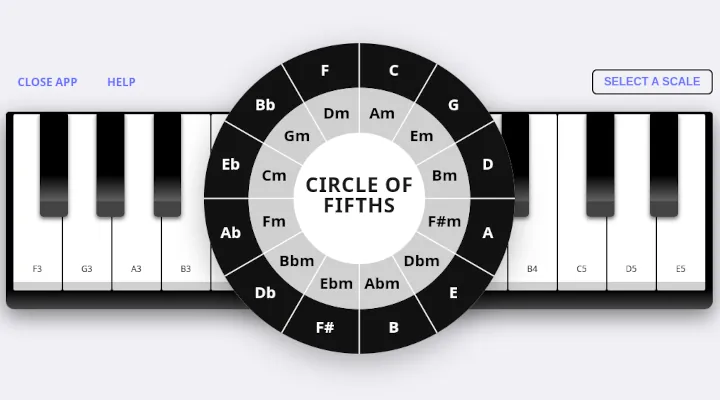
The Circle of Fifths: Your Musical Map
When you select "Select a Scale," you will see the Circle of Fifths. This is one of the most important illustrations in music theory. It is a visual map that shows how all twelve major and twelve melodic minor scales relate to one another.
By using this wheel to choose a scale, the student is not just picking a random set of notes; they are choosing a specific musical "mood" or "key" to explore.
The Workflow: Listen, Play, Repeat
To ensure the student builds a professional foundation, we follow a strict three-step process:
- Select: Choose a scale from the Circle of Fifths. Once selected, the circle will close, and the scale name will appear clearly on the screen.
- Listen: The app will play the scale once automatically. Listen closely to the sequence of notes.
- Practice: The student should play the scale five times. To make this easy and accurate, we have numbered the steps from 1 to 8.
The Importance of Precision
The numbered steps are designed to act as "guardrails." By following the numbers, the student minimizes wrong notes. This is vital because we are not just training the fingers; we are training the musical ear. To keep the ear in pristine condition, the student must hear the scale played perfectly every single time. Do not rush. Play slowly, and say the note names out loud as you play.
Understanding the Black Keys: Sharps and Flats
As the student moves into more advanced scales, they will encounter the black keys. Every black key actually has two different names depending on how you look at it. This is a fundamental concept in music theory.
The Sharp (#)
If a black note is located to the right of a white key, we use the name of that white key plus the word "sharp."
- C# (C Sharp)
- D# (D Sharp)
- F# (F Sharp)
- G# (G Sharp)
- A# (A Sharp)
The Flat (b)
If we name the black note based on the white key to its left, the name changes to "flat."
- Db (D Flat)
- Eb (E Flat)
- Gb (G Flat)
- Ab (A Flat)
- Bb (B Flat)
Note for Mentors: While guitarists often prefer the "sharp" names, musicians in bands (trumpet, clarinet, saxophone) frequently use "flat" names. Learning both is essential for a well-rounded musician.
A Note on Composition: This app is a stepping stone. By mastering these scales, the student is gaining the vocabulary required to become a true composer.