About 25 years ago, I was teaching piano and trumpet at a music school in Edmonton, Canada. In the afternoons, there was a constant coming and going: parents dropping off their children, picking them up, and popping into my studio for a quick chat if there was something to discuss.
One day, a mother carrying a small girl in her arms came to see me because Sarah wanted to ask me something. "Can I play the piano?" the little girl asked quietly. The question was simple. The answer, however, was not. While I knew that some kindergartens offered music programs, I wasn’t familiar with that specific approach to teaching.
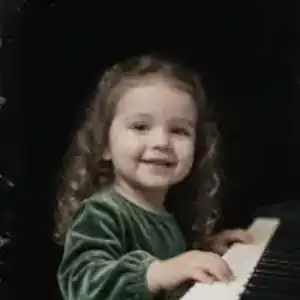
First, I asked how old Sarah actually was. Almost three, or to be precise: two years and ten months. With regret, I explained to Sarah that I only taught children who could count to twenty. The look in her eyes told me my answer was not the one she wanted.
But the following week, I had another visitor. This time, Sarah wanted to tell me something. Shortly after, she began to count. She counted slowly and flawlessly up to ten. Then, something happened that is hard to describe: her eyebrows knit together in deep concentration, and then came the numbers:
Since she didn't stop calling out numbers, I made a small hand gesture to signal that it was okay. I smiled and told her, "Yes, you can start." In that moment, the expression of intense concentration transformed into a Mona Lisa-like smile.
Normally, new students start with a beginner's book containing large notes and simple melodies. But Sarah was still in the pre-reading phase. I had to invent a completely new musical language, a language of symbols and images that allowed her to "see" the music without having to read notes.
In our first lesson, I took a piece of paper from the copier and asked for her permission to trace the outline of her right hand. For the note C, I drew a Camel. For the note D, we chose something that looked completely different: a Dolphin. And for the note E, we agreed on an Elephant.
After a few simple instructions, I pointed my pen at an animal, and Sarah played the corresponding note. To be honest, I was amazed that she immediately grasped the connection between the animal, which finger to press, and the piano key. No matter which animal I pointed to, she played absolutely flawlessly.
In the second week, we added a fish and a giraffe, allowing her repertoire to grow, and we were already playing our first well-known children's songs. By the third week, five notes were no longer enough, so we expanded the set with an alligator. I was astonished at how skillfully Sarah could use her little finger for two different notes. By then, we were already playing "Twinkle, Twinkle, Little Star."
As homework, I gave her a special challenge: she was to write and draw her own composition based on the notes we had learned. In hindsight, that was a great discovery: from then on, composing became part of her daily practice. To create even more possibilities, we also let the thumb "work double" to reach the note B. With that, a whole world of new songs opened up to us.
In our last lesson, I made copies of all the songs we had learned.
As the school year drew to a close, Sarah had learned so incredibly quickly that I invited her to perform at the big end-of-year concert, which was to take place in two weeks. Her mother, who always attended the lessons, agreed.
Sarah opened the concert. Her mother brought her onto the stage and helped her onto the piano bench. Since she was still far too small, she sat on two thick volumes of the Yellow Pages. Amidst the silence of the hall, she played her own composition. The audience was so thrilled that many shouted for an encore. I whispered to Sarah, asking if she would like to play her piece once more. She nodded and began to play again. Flawless, just like the first time. The auditorium was packed to capacity with about 200 guests, and the thundering applause of that moment remains unforgettable to me.
After the concert, several parents talked to me because they were fascinated by Sarah's progress and asked if their own toddlers could learn using this new method the following year.
During the subsequent summer break, I began to refine these hand-drawn sheets. I transformed the first sketches into a structured method, which was then used the following year with new students aged 3 to 5.
This experience with Sarah, and the years that followed, fundamentally changed my view of music pedagogy. I realized that the joy of making music doesn't have to wait until a child can read.
About the author
My name is Ernst J. Renner. I was born in Austria and emigrated to Canada in 1988, where I worked as a music teacher for many years. Now, retired in Vancouver, I develop the Pre Piano and Little Composers apps for preschool-aged children.