I have taught music on two continents, and learning note names has taught me that many children struggle, and falling behind is often the beginning of the end.
Therefore, I have created a very simple and basic app that really starts from zero, so that every child that spends time with the app can learn music notation. As you can see by the screenshot below, all complexity and distraction has been removed.
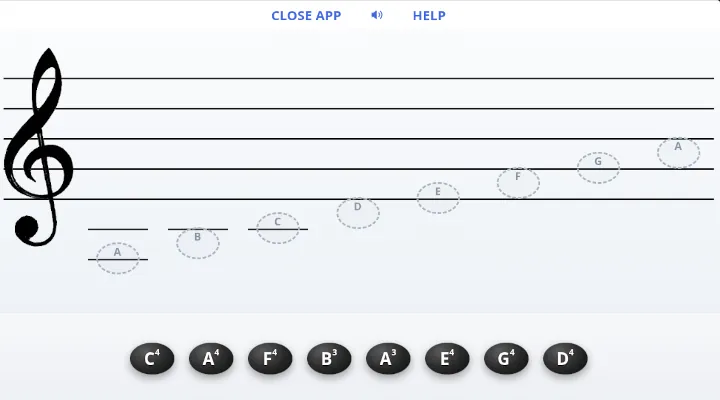
When the App Loads
A popup provides enough instructions to use the app.
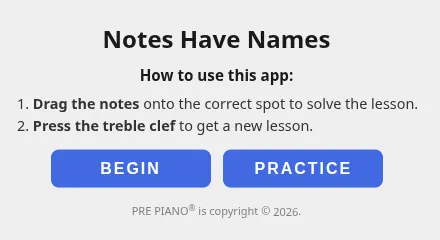
For children who are new to music notation, I recommend picking BEGIN for the first few sessions. For children who can solve the default level, the PRACTICE button loads the lesson right away and skips the default lesson. The faint dashed circles on the staff mark where each note belongs. A note that lands in the wrong spot simply bounces back to the tray, ready to be tried again.
The Staff
Music is written on five long lines and in the spaces in between. Since five lines can only hold so many notes, the range gets extended with short helper lines. Those helper lines have a name in music theory: ledger lines. All they do is add a short line, just enough to place a note on or below.
Music has a total of seven different notes. They are A, B, C, D, E, F, G. Once those have been used, note names repeat, just like the days of the week repeat. With seven day names, we can fill a whole year. Music works exactly the same. With seven note names, we can name every key on a grand piano that has 88 keys. This app works with a single octave: the eight notes from the low A up to the high A.
Each note in this app carries a small number after its letter, like A3 or A4. This is the octave. It tells musicians which A this is, the low one or the high one. Your child does not need to understand the number yet. The letter is enough. The number is there so the habit of reading full note names begins early.
Hint: Every fullsize grand or upright piano starts with the A key. So from left to right, the piano keys are A, B, C, D, E, F, G, and repeat all the way up to the last key.
The Treble Clef

Piano music is written on two staves and uses two clefs. The right hand plays in treble clef and the left hand in bass clef. Clefs provide a simple function, and once you understand what they do, music becomes easier. So what does the treble clef do? Initially, the fancy looking treble clef was the letter G, and if you look closely, you can see the swirl around the G note (second line from the bottom). So a treble clef states which note is the G, and all other notes are placed in reference to it. In contrast, the bass clef, which we will cover in another app, marks the F note.
Why use clefs? Without clefs, it would not be possible to write all 88 notes on a sheet of paper. By dividing the lower part and the upper part of the piano keys, it becomes possible to use music notation to cover the full range.
The treble clef in this app is smart. Every time a student presses the treble clef, it will write a new lesson to solve.
The Sound Button
Some students like to hear the real note sound, so we included this option. Every note that is solved plays the sound a piano would make if that note is played. When all of the notes have been solved, a little joyful melody plays. We use this melody to introduce a short break and to listen to some notes which our ear, in time, will learn to reference. Hearing music is the most valuable skill, and therefore I recommend keeping the sound on. But sometimes quiet is better or desired. For such situations, you can simply disable the sound by pressing the sound button.
How to Practice
Keep sessions short and end while your child still wants more. We recommend:
- One ordered round at the very start, so the child sees the whole octave laid out in order.
- Two or three shuffled rounds after that, with a short break in between.
- No race and no score. A wrong spot simply returns the note to the tray. There is nothing to fix, only the next try.
The ordered round teaches the map. The shuffled rounds are where reading actually begins, because your child has to recognize the spot instead of following it. That is the difference between this app and a quiz.
Notes Have Names is the first step in reading real music. It prepares your child for prePiano Three, where melodies are read on the staff, and it points the way toward our Scales app and the ear training courses that follow. The child who knows where A to A lives will find all of those places familiar.